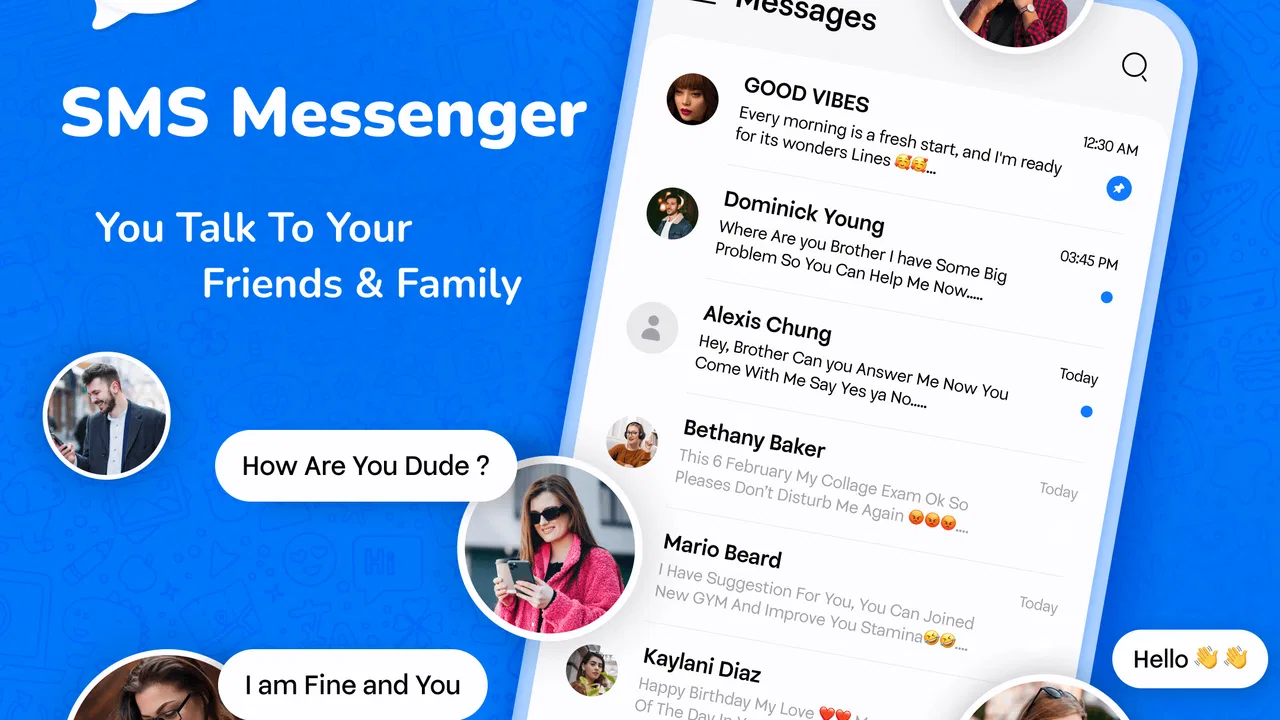
Messages
- 3.8
- Rating
- 1.00M
- Installs
- Free
- Price

 Analysis by App-foxy
Messages is the kind of Android communication app I reach for when I want texting to stay simple. It focuses on SMS and chat messages rather than trying to become a complete social platform, which makes the basic workflow easy to understand: open a conversation, write a reply, and send it without working through a crowded collection of extras. After spending time with it, I see the appeal for people who want a straightforward messaging tool, although I also found a few reasons why someone deeply invested in a larger messaging ecosystem may prefer a more established alternative.
The app is free to install, carries an Everyone content rating, and is developed by Text and SMS Messaging apps. Its current version is 2.8, and it works on devices running Android 8.0 or later. The app has passed the million-install mark and holds a 3.8 average from roughly ten thousand ratings, so it has attracted a substantial audience while still receiving a mixed rather than exceptional reception. That combination tells me to approach it as a practical everyday utility, not as a flawless replacement for every communication service.
How Messages fits into an everyday texting routine
I find Messages fits best when I treat it as a dependable place for everyday SMS rather than a hub for every kind of conversation. In this section, I’ll look at the small choices that make routine texting easier—especially keeping contacts recognizable and threads purposeful—before turning to what to check when the setup itself causes friction.
You May Also Like

 Blood Strike: 2.5 Anniversary
Blood Strike’s Loadouts Turn Every Drop Into a Tactical Gamble
A close look at Blood Strike’s custom loadouts: how fast access to signature weapons reshapes its battle royale rhythm, rewards preparation, and narrows the gap between fights.

 Pandora - Music & Podcasts
Pandora’s Music Is Easy to Start, but Harder to Recover
Pandora’s strength is its low-effort path from a seed to a station. Its weak spot is how much confidence it asks you to place in connection, setup, and quiet recovery.

 8 Ball Pool
 Is Built on Rivalries, Rematches, and Routine
A close look at the rivalries, rematches, shared routines, and unanswered safety questions that turn a quick pool match into a persistent mobile community.

 Samsung Music
’s Quiet Strength Is Playing What You Already Own
Its reach comes less from spectacle than from dependable access to a personal library. That simplicity is both the app’s strongest retention engine and its ceiling.

 AccuWeather: Weather Radar
AccuWeather Review: A Quick, Clear Forecast for Everyday Decisions
For everyday plans, the best forecast is the one you can understand quickly. AccuWeather makes rain timing, radar, and local conditions easy to act on, with a few trade-offs.

 Hill Climb Racing
Why Hill Climb Racing Still Turns Crashes Into One More Run
A tiny car, a bumpy hill and one more upgrade: Hill Climb Racing keeps resurfacing because its simple chaos makes every near-miss feel personal.
More From Our News Desk



A clean starting point for ordinary conversations
My first impression is that Messages makes sense for people whose communication needs are mostly familiar: keeping in touch with family, replying to a service provider, confirming an appointment, or sending a quick update to someone who may not use the same chat platform. SMS remains useful precisely because it reaches people without requiring everyone to join the same service, and this app keeps that purpose at the center.
The most useful way to judge it is not by how many decorative options it has, but by how little effort it takes to complete a normal exchange. I can think of a contact, open the relevant thread, read the recent context, and answer in the same place. That matters when I am standing in a queue, walking between tasks, or responding to a message that does not deserve the overhead of a full social app.
A realistic example is a family member asking me to confirm a pickup time. I do not need a group feed, a public profile, or a separate account-based community. I need to see the question, type a short answer, and know that the conversation remains easy to find later. Messages is well suited to that small but frequent kind of interaction.
Where the basic workflow is strongest
The app feels most comfortable when messages are short, conversations are one-to-one, and the purpose is clear. Appointment reminders, delivery coordination, school-related updates, and quick family check-ins all fit naturally. It is also a sensible option for someone moving from an older phone because the concept is familiar and does not demand a new social identity.
I would especially consider it for a household that wants a dedicated texting app instead of using a larger platform for every conversation. A parent who mainly exchanges brief updates with relatives may appreciate that the app stays focused. Likewise, a user with an older compatible Android phone can try it without paying an upfront purchase price.
That simplicity has a boundary. SMS is not the same as an internet-first messenger, and Messages should not be chosen on the assumption that it will automatically provide the richer collaboration, calling, media handling, or cross-device continuity associated with services built around accounts. If your daily conversations depend on large media files, live group coordination, or a shared workspace, a dedicated chat platform will usually be a better fit.
What I would check before making it my default
Before moving all my conversations into any texting app, I would first test the things that affect routine reliability: opening an existing thread, starting a new conversation, finding a contact, and returning to a recent exchange. I would also send a few ordinary messages to people I contact regularly rather than judging the app only from its first launch.
This is a useful habit because the right messaging app depends on how your phone handles conversations and contacts. If your address book is tidy, Messages should be easier to use than it would be on a device filled with duplicate entries or outdated numbers. Cleaning up contacts first can make the app feel faster even though the improvement comes from better organization rather than from a special feature.
I also recommend deciding whether you want this app to be your main texting tool or simply another option. Switching between multiple SMS apps can make it harder to remember which one contains the latest thread or controls notifications. For a fair trial, I would use Messages consistently for a few days, then assess whether conversations are easier to manage rather than changing back and forth after every message.
Settings that deserve attention
Experienced users rarely leave a communication app untouched. I would begin by reviewing notification behavior, especially if several messaging apps are installed. Duplicate alerts are distracting and can make it seem as though a message arrived twice. Giving one app a clear role helps: Messages can handle regular SMS while another service remains reserved for internet chats, or Messages can become the main inbox if it suits your contacts better.
Notification choices also affect privacy in ordinary situations. If message previews appear on a lock screen, someone nearby may read part of a conversation without opening the phone. I would check the device-level notification settings as well as the app’s own controls, because the phone’s system settings may determine what is visible when the screen is locked.
Another worthwhile check is the app’s permission behavior. Messaging tools often need access to contacts or notifications to make their central tasks convenient, but I prefer granting only what supports the workflow I actually use. If I only want to test the interface, I do not immediately give every optional permission. I first see which parts of contacting people and reading threads work with the permissions I am comfortable granting.
For users who share a phone, notification previews and conversation visibility deserve more attention than visual customization. A quiet, private notification is often more valuable than a bright alert that exposes the sender and message text. This is one of those small choices that does not appear in a short store summary but makes a real difference in daily use.
Building repeatable habits instead of searching every time
The fastest Messages workflow comes from reducing decisions. I like to keep frequent contacts easy to recognize in the phone’s contact list and to use consistent conversation names when group texting is involved. That way, I am less likely to open the wrong thread or send a personal reply into a group conversation.
For recurring tasks, I use a simple pattern: keep the message short, put the important detail near the beginning, and reread names and numbers before sending. This is particularly useful for practical texts such as “I will arrive at six,” where a mistaken recipient can cause more trouble than a slow interface. The app can make sending convenient, but a reliable habit still matters more than any shortcut.
I also find it helpful to separate urgent replies from messages that require research. If somebody asks me to confirm an address, I answer only after checking it instead of sending a vague response and correcting it later. Messages is good for quick communication, but its convenience can encourage impulsive sending. A two-second review is a better productivity feature than rushing through the final tap.
Useful patterns for families and small groups
Messages can work well for a small family group when the conversation stays practical. I would use one thread for a shared errand or event and avoid mixing unrelated subjects into it. When a group thread becomes a running archive of shopping requests, jokes, appointments, and old plans, finding the current detail becomes harder regardless of the app.
For that reason, I prefer starting a fresh conversation when the purpose changes significantly. It may feel less convenient in the moment, but it keeps later searching more manageable. This is a concrete way to get more value from a basic SMS tool without pretending it has the organization features of a project-management app.
There is also a trade-off with group texting: not every participant will handle the conversation in exactly the same way, and the experience can depend on their phones and services. I would not choose Messages as the center of a complex group project. For a quick family update, it is appropriate; for assigning tasks, sharing documents, or tracking decisions, a collaborative app is more dependable.
Where the app may feel limited
The main limitation is the narrowness that also makes Messages approachable. A focused SMS app cannot replace every function found in internet messaging services. If I need rich media conversations, extensive group tools, voice or video communication, or a conversation history that follows me seamlessly across several devices, I would look at alternatives designed around those needs.
There is also a financial detail worth noticing. The app is free, but in-app purchases range from $1.99 to $24.99 per item. That does not make the basic download unsuitable, but I would check what any optional purchase changes before paying. Someone looking for a completely cost-free experience should be comfortable using the free portion without assuming every convenience is included.
The rating of 3.8 from about 9.8K ratings reinforces my balanced view. Many people clearly find the app useful enough to install and keep, but the score is not a signal that every phone, preference, or messaging routine will feel equally comfortable. I would treat the trial period as important, particularly if I am replacing a familiar default app.
Comparing it with the usual alternatives
Compared with a phone’s built-in messaging application, Messages may appeal to someone who wants a different presentation or a separate texting environment. The advantage is not necessarily a dramatic change in what SMS can do; it is the possibility of finding a layout and routine that feel more natural. If the default app already handles conversations exactly as I want, switching may not offer enough benefit to justify relearning small details.
Compared with internet-first messengers, Messages has a different strength: it is aimed at ordinary text communication rather than requiring every person in a conversation to use the same account-based service. That makes it useful for contacts who are spread across different platforms. The compromise is that I should not expect the same depth of media sharing, presence indicators, group management, or multi-device features.
Compared with a feature-heavy communication suite, this app is easier to understand but less suitable for people who want one place for calls, communities, files, and rich conversations. I would recommend Messages to someone who values a focused inbox. I would steer a power user toward a broader alternative if their definition of messaging includes work coordination or frequent media exchange.
Who should install it, and who should skip it
I think Messages is a reasonable choice for an Android user who sends conventional texts, wants a free starting point, and prefers an uncluttered communication routine. It is also worth considering for people who need to reach contacts outside a single chat network or who are dissatisfied with the feel of their current SMS app.
I would be more cautious if your phone is central to a large group, if you depend on extensive multimedia sharing, or if you need conversations to remain perfectly synchronized across several devices. Those needs point toward a service built for internet communication rather than a focused SMS tool. I would also skip the switch if your current messaging app already feels reliable and its notification and privacy behavior suit you.
The Everyone age rating makes the app broadly approachable, but that does not remove the need for sensible family guidance. Children and teenagers may still receive unwanted messages through ordinary texting, so notification privacy, contact habits, and basic safety conversations remain important. The rating describes accessibility, not a guarantee that every incoming conversation will be suitable.
My verdict after settling into a routine
Messages succeeds when I ask it to do one job well: provide a direct place for SMS and chat conversations on Android. Its best qualities are focus, a familiar purpose, and a workflow that does not require a social account or a complicated setup. The app’s audience size shows that this straightforward approach has practical value, even though the average rating suggests a few users will find the experience less polished or less suitable than their preferred alternative.
My recommendation is conditional but positive. I would suggest trying it if your texting is mostly short, personal, and practical, especially when your contacts use different communication services. I would not present it as a universal replacement for every messenger. The best results come from pairing it with disciplined notification settings, a clean contact list, separate threads for separate purposes, and a quick review before sending sensitive or important messages.
For me, that is the real measure of this app: it can make everyday texting feel lighter when I keep expectations realistic. The free entry point makes testing easy, while optional purchases mean I would inspect extras carefully instead of assuming the entire experience is cost-free. If you want a focused Android texting app and your needs stay close to ordinary SMS, Messages is a practical option worth trying. If your conversations have evolved into rich media, collaborative work, or constant multi-device use, another category of messenger will serve you better.
FAQs for Messages
01What are the key features of the Messages app?
The Messages app offers a variety of features including text messaging, multimedia sharing (photos, videos, audio), and integration with other apps for enhanced functionality like location sharing and payments. It also supports group chats, emojis, and stickers, making communication more interactive and fun.
02Is the Messages app secure for personal and sensitive communication?
Yes, the Messages app provides end-to-end encryption for personal messages, ensuring that only you and the person you're communicating with can read what's sent. This encryption is automatic and helps protect your privacy, making it a secure choice for sensitive communication.
03Can I use the Messages app across different devices?
The Messages app is designed to work seamlessly across multiple devices. You can send and receive messages on your phone, tablet, and even your computer if supported. Syncing across devices is usually automatic, ensuring you have access to your conversations wherever you are.
04What customization options are available in the Messages app?
The Messages app offers various customization options to enhance your messaging experience. You can change chat backgrounds, set custom notification tones for specific contacts, and use a wide array of emojis and stickers. Additionally, you can personalize the app's theme to match your style.
05How does the Messages app handle group chats?
The Messages app supports robust group chat features, allowing you to add multiple participants, assign group names, and share multimedia files. You can also mute notifications, set do-not-disturb for individual chats, and manage group members easily, making it ideal for coordinating with friends or colleagues.
Pros
- User-friendly interface for easy navigation.
- Supports multimedia messages seamlessly.
- End-to-end encryption for privacy.
- Customizable notifications per chat.
- Integrates with other apps smoothly.
Cons
- Limited message organization features.
- No built-in translation for messages.
- Requires internet for multimedia sharing.
- Lacks advanced search capabilities.
- No themes for chat personalization.

Messages
Gallery